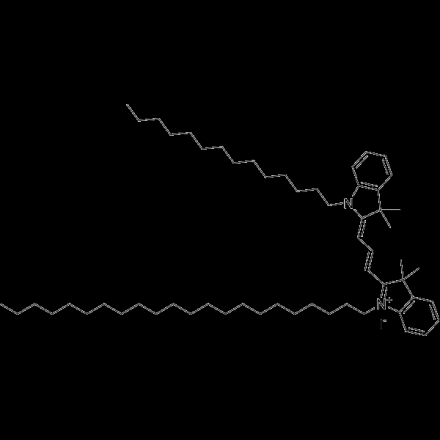

PKH 26
PKH 26 is a lipophilic fluorescent dye that is widely used in cell labeling, cell proliferation, and cell tracing, and has almost no toxic side effects, with an optimal excitation wavelength of 551 nm and an optimal emission wavelength of 567 nm.
Products are for research use only. Not for human use. We do not sell to patients.
Description
PKH 26 is a lipophilic fluorescent dye that is widely used in cell labeling, cell proliferation, and cell tracing, and has almost no toxic side effects, with an optimal excitation wavelength of 551 nm and an optimal emission wavelength of 567 nm[1-4].
The proliferation of human colon epithelial cells can be studied by labeling them with PKH 26(1∶250 (v/v)) [5]. PKH 26 can also be used to trace the effector induced apoptosis of target cells[6].
In rat autologous mature adipocyte transplantation, PKH 26-stained adipocytes could still be detected after 14.5 months[7]. Intravitreal injection of fluorescent (PKH 26)-labeled or exosomes (106 exosomes/μL) were given to the wild-type mouse or laser-induced Choroidal Neovascularization(CNV) mouse model. Intravitreally delivered PKH 26-labeled exosomes reached inner and outer retinal layers at 1 and 7 days post-injection after the intravitreal injection of exosomes[8].
References:
[1]. Horan PK, Slezak SE. Stable cell membrane labelling. Nature. 1989 Jul 13;340(6229):167-8. doi: 10.1038/340167a0. PMID: 2662017.
[2]. Horan PK, Melnicoff MJ, et,al. Fluorescent cell labeling for in vivo and in vitro cell tracking. Methods Cell Biol. 1990;33:469-90. doi: 10.1016/s0091-679x(08)60547-6. PMID: 2084480.
[3]. Samlowski WE, Robertson BA, et,al. Effects of supravital fluorochromes used to analyze the in vivo homing of murine lymphocytes on cellular function. J Immunol Methods. 1991 Nov 5;144(1):101-15. doi: 10.1016/0022-1759(91)90236-9. PMID: 1960398.
[4]. Fischer K, Mackensen A. The flow cytometric PKH-26 assay for the determination of T-cell mediated cytotoxic activity. Methods. 2003 Oct;31(2):135-42. doi: 10.1016/s1046-2023(03)00123-3. PMID: 12957571.
[5]. Pastò A, Marchesi M, et,al. PKH26 staining defines distinct subsets of normal human colon epithelial cells at different maturation stages. PLoS One. 2012;7(8):e43379. doi: 10.1371/journal.pone.0043379. Epub 2012 Aug 22. PMID: 22927961; PMCID: PMC3425557.
[6]. Drvar V, Ćurko-Cofek B, et,al. Granulysin expression and granulysin-mediated apoptosis in the peripheral blood of osteoarthritis patients. Biomed Rep. 2022 May;16(5):44. doi: 10.3892/br.2022.1527. Epub 2022 Mar 24. PMID: 35478928; PMCID: PMC9016702.
[7]. Rieck B. Unexpected durability of PKH 26 staining on rat adipocytes. Cell Biol Int. 2003;27(5):445-7. doi: 10.1016/s1065-6995(03)00036-2. PMID: 12758093.
[8]. Pollalis D, Kim D, et,al. Intraocular RGD-Engineered Exosomes and Active Targeting of Choroidal Neovascularization (CNV). Cells. 2022 Aug 18;11(16):2573. doi: 10.3390/cells11162573. PMID: 36010651; PMCID: PMC9406786.
Protocol
Protocol for cell fluorescence labelling using PKH-26 [1]:
Cells are transferred to polystyrene tubes and washed twice with serum-free medium before staining with the fluorescent membrane dye PKH26.
The cells are then resuspended in a loading buffer (an aqueous, osmolarity-regulating solution containing no Ca2+ or other physiological salts) and incubated for 40min with freshly prepared PKH-26 (stock 1 mM in ethanol) at room temperature.
For the loading of tumor cells, it is recommended to use 0.8 μl, for small cells (lymphocytes) 0.5μl PKH 26 in 200μl loading buffer. This dye solution is added slowly, while agitating the cell suspension on a shaker, in order to avoid overstained cells.
After 30-40min of shaking at room temperature, the loading of target cells is completed.
The staining reaction is stopped by the incubation with 500μl human serum for 30s at room temperature. This step is recommended to bind most of the residual lipophilic PKH-26 dye to serum proteins.
After centrifugation, the cell pellet is transferred into a fresh 50ml tube and washed twice with 40ml medium containing 10% human serum. It is important to abide by the washing procedure in order to remove all PKH-26 in the supernatant completely.
Coincubation of effector and target cells should be performed in effector cell medium. PKH-26 labelled target cells (5×10³) are plated in 100 μl medium/well.
Harvesting of cells and staining with ann-FITC and PI. After the co-incubation, cells are harvested into separate polystyrene tubes.
1ml phosphate buffered saline (PBS) is added and cells are centrifuged. Cells are then resuspended in 100 ul high calcium annexinV-binding buffer. Staining with 5μl ann-FITC is performed for 10min at room temperature in the dark.
FACS analysis was carried out. The excitation is at 488 nm, the fluorescence of PKH-26 at 585 nm. For compensation, both unstained and PKH-26 stained cells should be prepared.
This protocol only provides a guideline, and should be modified according to your specific needs.
Protocol for cell proliferation using PKH-26 [2]:
The cells were inoculated in 6-well plates and cultured in medium.
Wash with PBS twice and incubate with 1:250 (v/v) PKH26 solution for 3 minutes.
Replace the culture medium with 1% BSA and block staining.
Timely passage according to cell proliferation.
Examine the plates daily with a phase-contrast microscope to assess the formation of spherical structures and take photographs.
The cells stained with PKH26 were observed by fluorescence microscope, and the images were taken by confocal microscope.
This protocol only provides a guideline, and should be modified according to your specific needs.
Protocol for intracellular uptake of exosomes in mice using PKH-26 [3]:
For fluorescent labeling of the exosomes, resuspended in 1 mL Diluent C exosome pellets and 1 mL Diluent C mixed with 4 μL PKH-26 were incubated for four minutes. Then, 10% BSA was used to stop the labeling reaction. Labeled exosomes were isolated and purified by sucrose density gradient ultracentrifugation (41,000 RPM for 120 min at 4℃).
Intravitreal Injection of Exosomes. C57BL/6J 4-6-week-old mice received intravitreal injection of PKH-26 labeled exosomes. Laser-induced CNV(Choroidal Neovascularization) mouse models received intravitreal injection exosome treatment three days after laser photocoagulation. For intravitreal injection, mice were anesthetized with IP ketamine (100 mg/mL)/xylazine (100 mg/mL) and pupils were dilated with 2.5% phenylephrine/1% cyclopentolate. A small scleral incision was made posterior to the limbus using a 31-gauge (G) insulin needle. Then, a 33G blunt needle attached to a 10 μL NanoFil syringe was used to deliver 1 μL (106 exosome particles/1 μL) of solution in the vitreous cavity through the same incision.
Intravenous Injection of Exosomes. C57BL/6J 4-6-week-old mice received an intravenous injection of PKH-26-labeled exosomes through the tail vein (5×10⁷ exosome particles/50 μL).
In Vivo Imaging Analysis. Fundus photography, in vivo retinal imaging microscopy, and fluorescein angiography (FA) were performed using the Micron IV retinal imaging system. Mice were anesthetized with IP ketamine (100 mg/mL)/xylazine (100 mg/mL) and pupils were dilated with 2.5% phenylephrine/1% cyclopentolate. For FA, mice received an intraperitoneal injection of 10% of fluorescein sodium. Optical coherence tomography (OCT) was performed using OCT.
This protocol only provides a guideline, and should be modified according to your specific needs.
References:
[1]. Fischer K, Mackensen A. The flow cytometric PKH-26 assay for the determination of T-cell mediated cytotoxic activity. Methods. 2003 Oct;31(2):135-42. doi: 10.1016/s1046-2023(03)00123-3. PMID: 12957571.
[2].Pastò A, Marchesi M,et,al. PKH26 staining defines distinct subsets of normal human colon epithelial cells at different maturation stages. PLoS One. 2012;7(8):e43379. doi: 10.1371/journal.pone.0043379. Epub 2012 Aug 22. PMID: 22927961; PMCID: PMC3425557.
- Pollalis D, Kim D, et,al. Intraocular RGD-Engineered Exosomes and Active Targeting of Choroidal Neovascularization (CNV). Cells. 2022 Aug 18;11(16):2573. doi: 10.3390/cells11162573. PMID: 36010651; PMCID: PMC9406786.
Chemical Properties
Cas No. 154214-55-8 SDF
Formula C59H97IN2 M.Wt 961.32
Solubility DMSO:1.67 mg/mL (1.74 mM) Storage Store at -20°C,protect from light
General tips Please select the appropriate solvent to prepare the stock solution according to the solubility of the product in different solvents; once the solution is prepared, please store it in separate packages to avoid product failure caused by repeated freezing and thawing.Storage method and period of the stock solution: When stored at -80°C, please use it within 6 months; when stored at -20°C, please use it within 1 month.
To increase solubility, heat the tube to 37°C and then oscillate in an ultrasonic bath for some time.
Shipping Condition Evaluation sample solution: shipped with blue ice. All other sizes available: with RT, or with Blue Ice upon request.