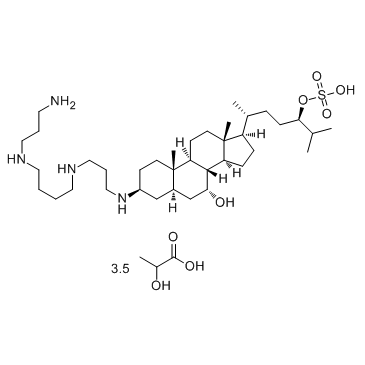

MSI-1436 lactate (Trodusquemine lactate)
MSI-1436 lactate (Trodusquemine lactate) is a selective, non-competitive inhibitor of the enzyme protein-tyrosine phosphatase 1B (PTP1B), with an IC50 of 1 μM, 200-fold preference over TCPTP (IC50 of 224 μM).
Products are for research use only. Not for human use. We do not sell to patients.
MSI1436 lactate is a selective, non-competitive inhibitor of the enzyme protein tyrosine phosphatase 1B (PTB-1B), with an IC50 of 1 μM, 200-fold preference over TC-PTP (IC50 of 224 μM).
In HepG2, MSI-1436 (10 µM, 30 min) alone has no effect on phosphorylation of IRβ, but in conjunction with 100 nM insulin, MSI-1436 increases p-IRβ 18-fold over untreated cells and by approximately threefold over cells treated with insulin alone. MSI-1436's inhibition of TCPTP is approximately two logs less than the effect on PTP1B activity, with a resulting IC50 value of 224 µM[1]. MSI-1436 (Trodusquemine, 10 μM) restores ERK phosphorylation in response to mGluR1/5 agonist DHPG in F11 neuronal cells. MSI-1436 (10 uM) rescues DHPG-induced holding currents and restores DSI in LMO4KO BLA neurons[2]. MSI-1436 (0.1-100 µM) blocks PTP1B activity, has insulin-mimetic effects in cultured neuronal cells[3].
MSI-1436 (10 mg/kg, i.p.) causes obesity-dependent body weight, reduces total body fat content and adipocyte size and lipid content of white adipose tissue of mice. MSI-1436 treatment significantly reduces plasma insulin levels. MSI-1436 (10 mg/kg, i.p.) increases phosphorylation of STAT-3 2.7-fold and, in conjunction with 100 U/kg insulin, p-IRβ increases threefold over insulin alone-treated rats[1]. MSI-1436 (Trodusquemine) exhibits anxiolytic effect through a restoration of endocannabinoid (eCB) signaling within the amygdala[2]. MSI-1436 (5 mg/kg, i.p.) has an anti-diabetic effect on diabetic mice, and is sufficient to suppress food intake and cause weight loss in CD1 mice[3].
- Lantz KA, et al. Inhibition of PTP1B by trodusquemine (MSI-1436) causes fat-specific weight loss in diet-induced obese mice. Obesity (Silver Spring). 2010 Aug;18(8):1516-1523. [2]. Qin Z, et al. Chronic stress induces anxiety via an amygdalar intracellular cascade that impairs endocannabinoid signaling. Neuron. 2015 Mar 18;85(6):1319-31. [3]. Qin Z, et al. Functional properties of Claramine: a novel PTP1B inhibitor and insulin-mimetic compound. Biochem Biophys Res Commun. 2015 Feb 27;458(1):21-7.
Protocol
Kinase experiment: Human kinases activities are measured. In brief, 256 DNA-tagged kinases, ligand affinity beads, and MSI-1436 lactate (10 μM) are incubated at room temperature, washed, and then eluted. Phage titer in the eluates is quantitated by real-time quantitative PCR[1].
Cell experiment: Quantitation of phosphatase activity is measured using an intact cell assay. Hep G2 cells are pretreated with 10 μM MSI-1436 lactate or sodium orthovanadate (100 μM, postive control) for 10 min at 37 °C, then incubated with 10 μM pNPP (a cell permeable hydrolysable substrate) for 30 min at 37 °C. Samples of the supernatants are spectrophotometrically analyzed at OD405 for hydolyzed pNP, a direct end product of phosphatase activity[1].
Animal experiment: Male AKR/J mice are randomly placed on ad libitum 10, 45, or 60% fat kcal diets. After 14 weeks, mice are randomly assigned to three treatment groups (n=5 to 8 mice/group); MSI-1436 lactate (initial dose of 10 mg/kg with three subsequent weekly doses of 5 mg/kg, intraperitoneally), vehicle (saline, 10 mL/kg, weekly 4×), or pair-fed (PF). PF animals are injected with saline (weekly 4×) and allotted the amount of food consumed daily by MSI-1436 lactate -treated animals. On day 23, mice are anesthetized and euthanized for blood and tissue collection, respectively. Plasma is obtained following centrifugation of blood 14,000 rpm for 10 min at 4°C[1].
References:
[1]. Lantz KA, et al. Inhibition of PTP1B by trodusquemine (MSI-1436) causes fat-specific weight loss in diet-induced obese mice. Obesity (Silver Spring). 2010 Aug;18(8):1516-1523.
[2]. Qin Z, et al. Chronic stress induces anxiety via an amygdalar intracellular cascade that impairs endocannabinoid signaling. Neuron. 2015 Mar 18;85(6):1319-31.
[3]. Qin Z, et al. Functional properties of Claramine: a novel PTP1B inhibitor and insulin-mimetic compound. Biochem Biophys Res Commun. 2015 Feb 27;458(1):21-7.
Chemical Properties
Cas No. 1309370-86-2 SDF
Synonyms Trodusquemine lactate; Aminosterol-1436 lactate
Canonical SMILES NCCCNCCCCNCCCN[C@@H]1C[C@@](C[C@@H](O)[C@]2([H])[C@]3([H])CC[C@@]4(C)[C@@]2([H])CC[C@@]4([C@H](C)CC[C@@H](OS(=O)(O)=O)C(C)C)[H])([H])[C@]3(C)CC1.O=C(O)C(C)O.[3.5]
Formula C37H72N4O5S . 7/2C3H6O3 M.Wt 1000.17
Solubility DMSO : 54 mg/mL (53.99 mM);Water : ≥ 33.33 mg/mL (33.32 mM) Storage Store at -20°C
General tips Please select the appropriate solvent to prepare the stock solution according to the solubility of the product in different solvents; once the solution is prepared, please store it in separate packages to avoid product failure caused by repeated freezing and thawing.Storage method and period of the stock solution: When stored at -80°C, please use it within 6 months; when stored at -20°C, please use it within 1 month.
To increase solubility, heat the tube to 37°C and then oscillate in an ultrasonic bath for some time.
Shipping Condition Evaluation sample solution: shipped with blue ice. All other sizes available: with RT, or with Blue Ice upon request.